Custom Operational Tools for Small Teams

GlidePath helps small businesses run better.

In small business, the gap between trying AI and having Grounded Intelligence integrated into the daily flow is enormous. GlidePath finds the friction in today's operations and then builds the custom tools that remove it. Tools shaped around how the business actually runs, not a vendor's template.

Let's Talk About Your Business Book an Intro Call

What GlidePath Builds

Custom Business Tools is the core of the practice: operational tools built around how a business actually runs.

Most of the work comes down to one thing: information that does not move the way it should. A quote revision sitting in someone's inbox. A policy nobody can find. A spec sheet that gets retyped every time. GlidePath finds where information gets stuck and builds the tool that gets it moving.

  • Staff use tools that fit how they already work. Nobody has to change their routine for new software.
  • Some tools include Grounded Intelligence: answers pulled from a business's own documentation, with the source cited, and an honest "that's not on file" instead of a guess.
  • The question is never "where can we add AI?" It's "what does this workflow actually need?"
See how it's built →

Where GlidePath Works

Two kinds of operations right now.

Small Medical Practices

Small medical practices

A practice operating system: a connected set of tools for how the practice actually runs, built one piece at a time.

  • Family intake, screening, and patient education in one front-office flow
  • A staff knowledge base that answers from the practice's own procedures, with the source cited
  • A timeclock that runs through the messaging app the staff already uses
See the work →
Lighting Industry

The lighting industry

  • Quote and order tracking, catalog automation, and sales intelligence tools, built by someone who sold in this industry for three decades
  • CEU development and delivery, accredited through AIA and LACES, plus sales leadership consulting and lighting design
See the work →

See It Built

  • Quote Atlas. A live, fully working demo of a lighting agency's project and order-tracking system.
  • The Pediatric Practice Suite. Family intake, screening, and patient education for a small medical practice.

Both run on fictional data and are free to open.

Explore the Portfolio →

What GlidePath Brings

Owner-built, for owners. The tools are just the speed.

01

Outcomes first, tools second

Every engagement starts with the client's problem, not a product, and maps what is actually happening before anything gets built.

02

Built it, not just consulted on it

Thirty years working in and serving small businesses, including founding an agency and taking it from zero to $18M.

03

Design and engineering trained precision

Formal training in both shapes the approach: precision, collaboration, and serving the client's vision.

04

A builder and a coach, on the team, not a vendor

Experienced fractional capacity without a full-time hire, and a standing relationship after handoff. The first call when something needs attention, not a subscription's helpdesk chatbot.

If something in your operation is costing more time than it should, that is the conversation to start with.

Let's talk about your business →
What it means for your business

A tool you can actually trust

You have heard what AI can do. You have also heard the horror stories: tools that sound confident and get it wrong, that put staff or customers on bad information. Grounded Intelligence is built to be trustworthy. It works from your business's own knowledge, not the open internet, so the answers fit your business because they come from it.

Why it is safe to put in front of your team

It admits when it doesn't know

A tool that guesses is worse than no tool. Your people stop trusting it... or they trust it when they should not. Grounded Intelligence does the opposite. When the answer is not in your records, it says so. That is what makes it safe to hand to a new hire on their first day.

What you get

Built around your priorities

01

Your team, self-sufficient

Staff get answers on their own, instead of routing every question back to you.

02

Output you can trust

Answers come from your own knowledge, not a guess. You are not betting your business on a confident-sounding paragraph.

03

A tool that stays yours

Your knowledge and your data are not handed to someone else's platform. What GlidePath builds belongs to you.

Proof

What it looks like in practice

The owner stopped being the help desk

A clinic's staff now ask the system and get answers in tune with how the practice works, drawn from its own procedures. The owner recovered his time, and the practice runs on his knowledge instead of his availability.

A coach's philosophy, not a stock product

GlidePath built a coaching tool that learns how a coach actually thinks: how they pick lines, read players, and run their season. Its guidance is grounded in that philosophy, so its recommendations are ones the coach immediately feels they can use, not a generic playbook. The same approach tunes a tool to how your business decides, instead of a vendor's template.

Want a tool your team can actually trust?

Let's talk about where it fits.

Book an Intro Call
Primary Practice

Custom Business Tools

Every tool GlidePath builds is different. The way it gets built never is.

GlidePath builds operational tools shaped around how a business already runs. Some include Grounded Intelligence; some are purely operational. The question is never "where can we add AI?" It's "what does this workflow actually need?"

Proof. A coaching tool built around one coach's own philosophy, in their own words. It writes player assessments grounded in their standards, not a generic template.

Six standards, every build

Fits how you work

GlidePath maps what your team does today, then builds to match. Nobody relearns their job to suit the software.

Starts with the goal

The first question is what you need to happen. The technology gets chosen last.

Grounded in your business

It works from your own records and rules. It shows where an answer came from, and says "that's not on file" when it isn't.

Proven before you see it

Tested on real work, then handed to a reviewer whose only job is to break it.

Simple on purpose

Every part earns its place. Less to learn, less to break.

Yours to keep

You own the tool and the data. No subscriptions, no lock-in, and it is built to run without GlidePath.

How it goes
  1. Listen. GlidePath maps how the work really happens, with the people who do it.
  2. Agree in plain English. Before anything is built, you see what it will do and what done looks like.
  3. Build one piece. Small, useful, and working end to end on your real work.
  4. Try to break it. GlidePath finds the failures so your team does not.
  5. Hand it over, stay close. It is yours, it is documented, and GlidePath is the first call.
How you buy it
  • A fixed, three-month engagement to install the substrate and build the first tool.
  • From there, some clients move into an ongoing retainer: GlidePath keeps watching the systems and flags what's next.
  • Training is available alongside either, billed separately.
See engagement models →

GlidePath Consulting exists to help small businesses, and the people running them, work better. The work has always been about people, operations, and outcomes. The tools are just how it gets done now.

Today

The current work

The newest layer is also the most useful one for most clients right now: bringing modern AI tools to small business operations. Find the friction. Build the fix. Hand it off in a way the team can actually use and maintain.

Billy has spent thirty years as a specifier, a teacher, and a problem solver. He speaks the language of small business operations, technical specifications, and organization building because he has built organizations, written specs, and run the operations himself. The AI work is grounded in that history.

Our Approach

How we build

Most business software is designed for "most companies": an average-case product, sold at scale, customized only around the edges. GlidePath works the other way. The operation gets mapped first. The tool gets built to fit what it finds, not the other way around.

The elegance is not in the code. The elegance is in the fit. Not making a team change how it works to accommodate the system... that IS the achievement. Customers reign supreme. They do not serve the software. Quite the contrary.

GlidePath exists because the knowledge and process discipline required to build durable operational systems (knowledge that accumulated across thirty years in a demanding industry) should not require enterprise resources to access. Small business owners deserve the same rigor. They rarely get it because the people who have it are priced out of reach, or too focused on clients who have more zeros in the budget.

Everything GlidePath delivers moves through a defined process: discovery before design, design before build, adversarial review before client exposure, and documented support from the day it goes live. Not because the process is impressive. Because the alternative (shipping something and hoping it holds) is the exact failure mode this practice exists to prevent.

The build is not the deliverable.

Their success is.

Background

The designer

Billy's career started in light: architectural and theatrical lighting design, with projects spanning coast to coast. The FDR Memorial on the National Mall. CityWalk at Universal Studios Hollywood. Staples Center. The Longwood Gardens Meadow. The Henrybuilt Showroom in Brooklyn. Design work teaches precision, collaboration, and how to serve the person on the other side of the drawing. Those instincts don't go away.

The principle I carry into every build comes from that world. A former principal of mine had no patience for clever solutions that made a project harder to coordinate: pick the tool that serves the spec, connect it in the most direct way possible, nothing precious.

Billy taught at UCLA and speaks regularly at Penn State's Architectural Engineering department. Founding member of Project Candle. Long-standing member of both IES and IALD. The industry relationships are real and longstanding.

Background

The business builder

He moved to the commercial side: specification sales first. Design credibility opened doors no other rep could access. Then the manufacturer side: he managed rep agency networks across Eastern US and Canada, doubled territory sales. VP of Specification Sales and Marketing at a major agency, running spec teams and manufacturer relationships.

In 2012, he founded Digital Filaments from scratch. Grew it to $18M in annual sales with a linecard of over 150 brands, in one of the most competitive spec markets in the country. Along the way, he co-founded what became the NEMRA Lighting Division, a national organization built to professionalize the independent rep model. Both sides of the table, up close, over a long time.

Research

Circle of Light™

On a construction project, the lighting outcome depends on more than the specification. Circle of Light describes the people whose decisions shape it, and how information and responsibility move between them. The same questions run any small business: who does the work, who decides, and whose information never reaches the decision.

Explore Circle of Light →

Affiliations & Credentials

Certified Professional Manufacturer Rep (CPMR)  ·  Co-founder, AAILA (now NEMRA Lighting Division)  ·  Founding member, Project Candle  ·  Former UCLA instructor  ·  IES and IALD member

LinkedIn

That is the background. The question that matters is what your operation needs next.

Let's talk →
← Back to About

The model

Every project has a circle

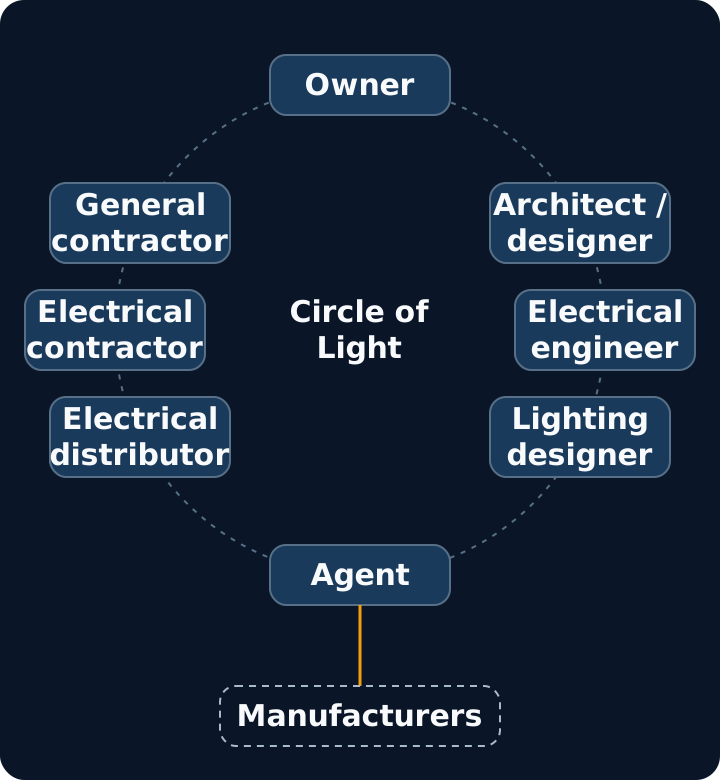
On a construction project, the lighting outcome depends on more than the specification. Circle of Light describes the people and organizations whose decisions shape it: the owner, the design team, the builders and suppliers, and the agent who represents the manufacturers. Every project has a different circle. Roles can be missing, and one firm can fill several.

Circle of Light diagram. Owner at the top and agent at the bottom, both on the circle. Architect or designer, electrical engineer and lighting designer grouped on the right. General contractor, electrical contractor and electrical distributor grouped on the left. Manufacturers sit outside the circle, connected through the agent. The open middle is labeled Circle of Light.
The ideal view: every role on the circle, with equal weight. The middle stays open.
How it moves

Information and responsibility flow both ways

The circle is not hub and spoke. Information and responsibility move around it in both directions, and a central coordinating role exists only when someone takes it. The agent works from the perimeter, looking in, trying to understand and influence everything it can to win the order.

Relationships, motivations, and incentives decide whose information reaches a decision, and whether the original design intent survives bidding, substitution, and delivery.

An illustration: the substitution

A fixture is specified during design. At bid time, a lower-priced substitute is offered. Whether the owner still gets the intended result depends on who sees the substitution, what they know about why the original was chosen, and whether that reason was ever written down.

The research

What changes when the tools change

Modern tools, AI among them, are changing how information moves around the circle. GlidePath is talking with people across it (designers, engineers, contractors, estimators, agents, and manufacturers) about how their firms use these tools. The research starts from questions, not conclusions:

  • Where does information get lost between design and delivery?
  • Who checks what a tool produced before it goes out under a firm's name?
  • Which roles are the new tools absorbing, and which are they creating?
  • What does a firm decide before it lets AI touch project information?

The model has been taught for years to lighting and architectural engineering students, most recently in a September 2026 session with Penn State Architectural Engineering students, using lighting as a case that applies across disciplines.

Why it matters here

The same questions run a small business

Who does the work, who makes the decision, and whose information never reaches it? GlidePath asks those questions before choosing any tool. Most of the friction in a small business turns out to be information that does not move the way it should.

Have a project story?

If you work anywhere on the circle and have seen design intent survive a project, or get lost along the way, GlidePath would like to hear it.

Share a project story →
Illustration: a clinic staff member finds an answer on a tablet while a practice owner works undisturbed at his desk.
Small Medical Practices

A practice operating system, built one piece at a time (Physical Therapy Practice)

Challenge

The owner was everyone's source of truth. Every question found its way back to him even though he had already done the work. Policies written. Processes documented. Institutional knowledge captured. None of it reachable at the moment staff needed it.

What got built, in order

First a staff knowledge system: the practice's own documentation, put where staff actually work, answerable by question, without filtering through the owner. Then a timeclock that runs inside the messaging app the staff already used every day, so nobody had to learn new software. Each piece sits on the same foundation as the one before it.

Where it stands

Staff stopped asking the owner what he had already answered. He recovered time. The practice runs on his work now, not his availability. Active retainer, ongoing, with the next module added when the practice is ready for it.

Illustration: two people greet each other at the open door of a small practice, with a third person seated in the lit room inside.
Small Medical Practices

Web Presence (Private Psychology Practice)

Challenge

Twenty years of full practice built entirely on word of mouth. No website, no LinkedIn, no online footprint... intentionally. Then colleagues started sending referrals who couldn't find her. The absence that had always been a choice started to feel like a liability.

Solution

GlidePath built a minimal, elegant web presence: static site, custom logo, professional headshot. Designed as a referral touch point, not a content hub. Simple, findable, nothing that needs constant tending.

Results

Findable. Contactable. The word-of-mouth network that built her practice over twenty years can now complete the loop.

Illustration: a sales representative reads a tablet beside a plain parked car outside a low office building.
Lighting Industry

Sales Intelligence System, AI-Enabled (National Sales Agency)

Challenge

Post-meeting documentation and client follow-up consuming significant rep time. Critical context scattered across notes and email with no reliable way to surface it.

Solution

GlidePath built a triage tool that processes meeting notes, surfaces follow-up priorities, and maintains running client context the rep can reach in the field.

Results

Hours recovered per week. Client relationships managed with greater consistency and less effort.

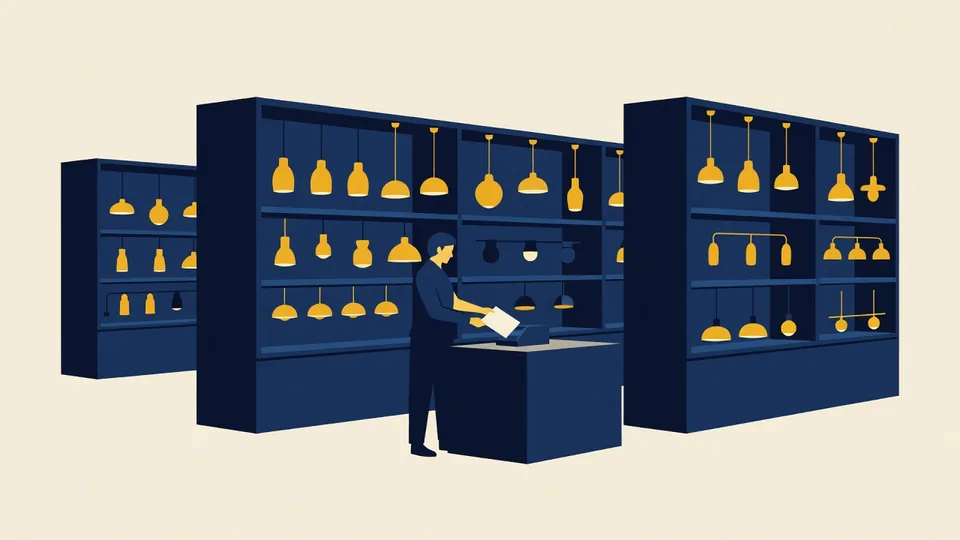
Illustration: a warehouse worker feeds a sheet of paper into a scanner in front of racks of lit pendant lamps.
Lighting Industry

Catalog Automation System, AI-Enabled (Lighting Solutions Importer)

Challenge

Thousands of products available to catalog and inventory from vendors around the world... and a few hundred actually on the website. Factory spec sheets arriving formatted for the factory floor, not for catalog upload. Every product required manual translation, reformatting, and data entry by someone who knew the system. The catalog couldn't grow without the team growing with it.

Solution

GlidePath designed and built an automated processing pipeline. Staff upload a factory spec sheet; the system extracts the relevant data, validates it against the catalog's attribute schema, and outputs a file ready for direct upload. No AI interface for employees. No new skills required.

Results

The catalog backlog became workable. New suppliers and new product lines processed continuously... without proportional headcount.

If a story like one of these sounds like your operation, that is worth a conversation.

Let's talk about your business →
Small Medical Practices

Small-Practice Front Office Suites

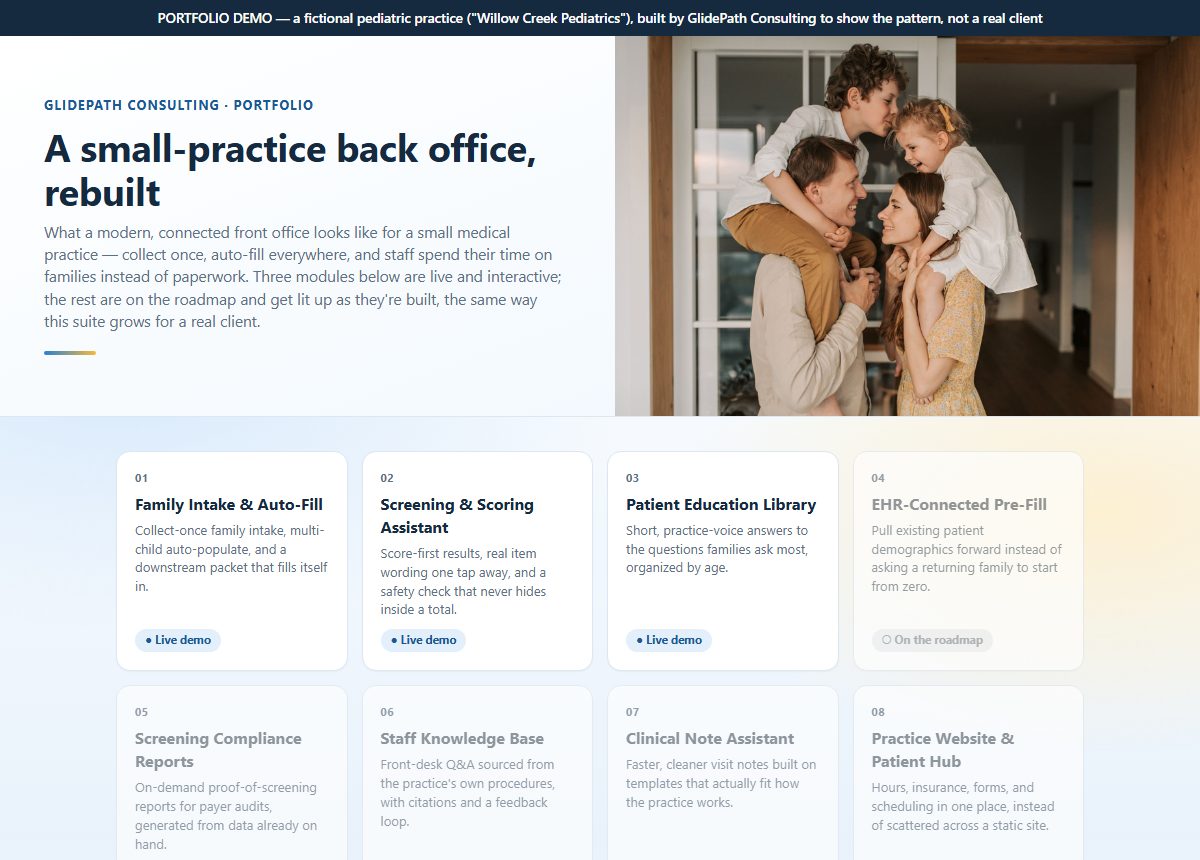
A small medical practice's front office runs on the same intake, screening, and patient-communication paperwork visit after visit. GlidePath builds a connected suite around that: enter family information once and have it auto-fill everywhere, score-first screening with the real question wording one tap away, and a patient education library in the practice's own voice. One module ships, the next gets added on the same foundation.

Pediatric practice suite: family intake, screening, and patient education modules
Live demo

Pediatric Practice Suite -- Family Intake, Screening & Patient Education

Collect-once family intake auto-fills every downstream form for every child. A screening assistant scores results first, with the real item wording one tap away and a safety check that fires independently of the total. A searchable patient education library answers the questions families ask most. Nine additional modules are roadmapped on the same hub. Public demonstration, fictional data.

Launch Demo
Small Medical Practices

Staff Knowledge Systems

The owner of a small practice is usually everyone's source of truth. Every question finds its way back to them, even for things they've already documented. GlidePath builds a tool that puts that knowledge where staff actually work: available instantly, by question, without filtering through the owner.

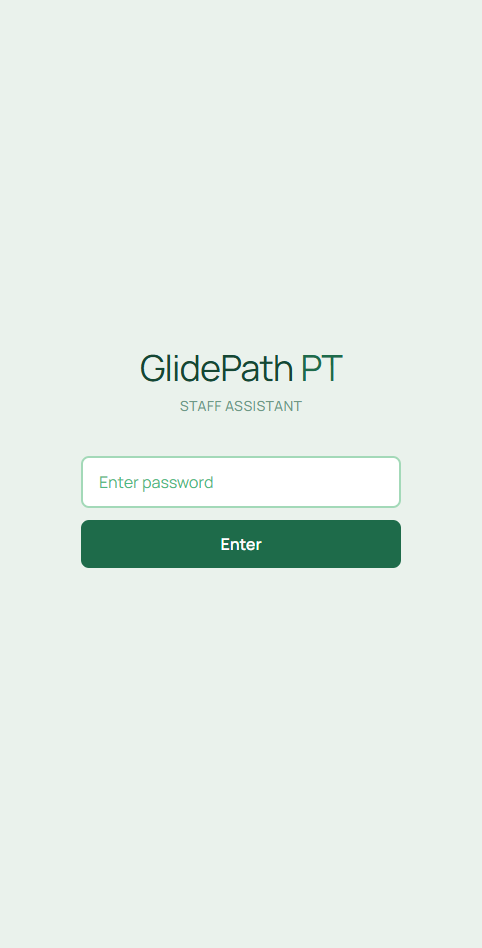
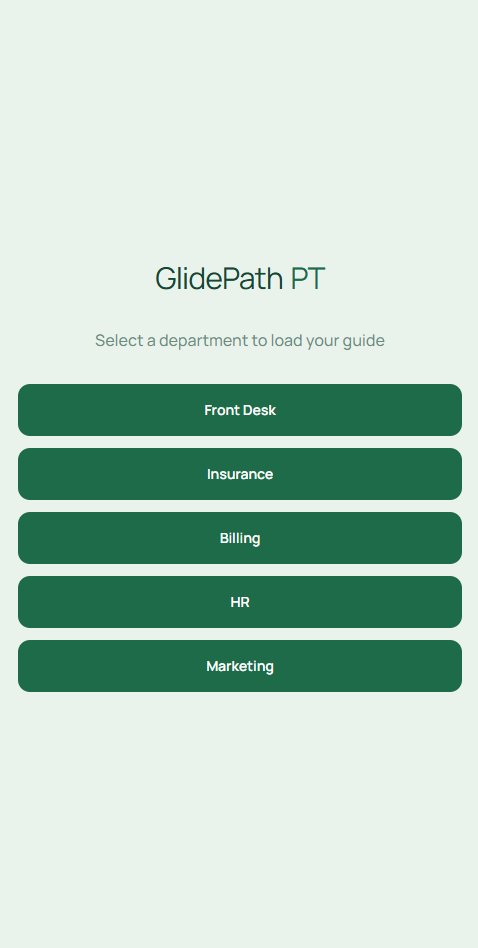
Staff assistant login screen Department module selector Owner dashboard with practice metrics
Live demo

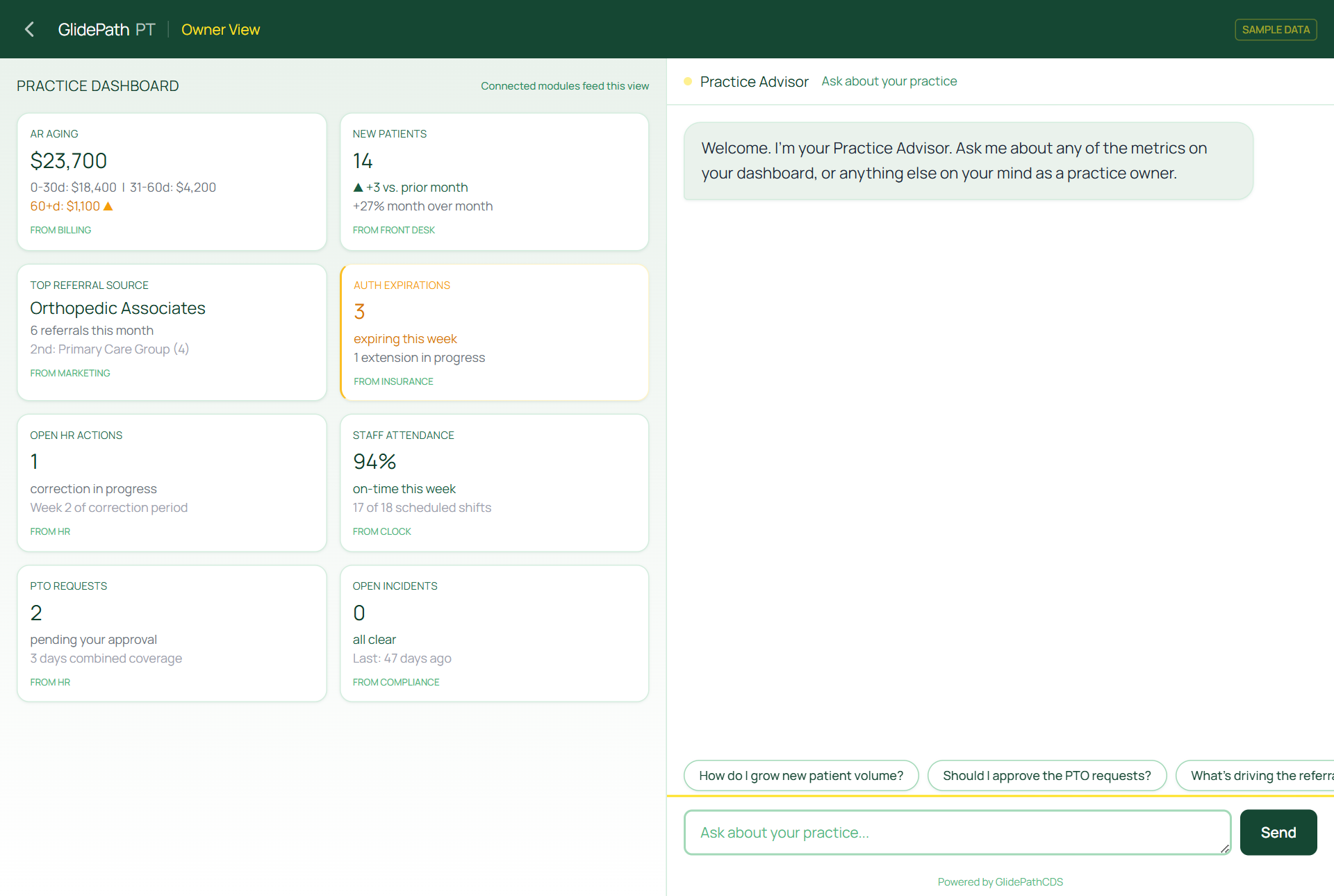
Staff Assistant + Owner Dashboard -- Physical Therapy Practice

Nine department modules covering the full staff operation -- Front Desk, Insurance, Billing, HR, Marketing, Clinical, Compliance, and Facilities -- plus an Owner View: a live practice dashboard with key operational metrics and a Practice Advisor chat. Answers are pulled from the practice's own procedures, with the source cited: GlidePath's Grounded Intelligence approach.

Try it yourself

Live at gppt.glidepath-consulting.com

Launch Demo

Staff Knowledge System, Physical Therapy Practice. In production on an active retainer. Read the full story →

Small Medical Practices

Staff Operations Tools

Operational tools that run inside the infrastructure a team already uses. No new app to install. No new login to remember. Built around existing tools and existing habits, because the elegance is in the fit, not the technology.

Production engagement

Staff Timeclock -- Physical Therapy Practice

GlidePath built a timeclock system that runs through the messaging app staff already used every day. Clock in, clock out, shift notifications, all through existing infrastructure. No new tool. No new habit required.

Lighting Industry

Project, Quote & Order Systems

Sales opportunities collect people, pricing, follow-ups, revisions, orders, and acknowledgments. GlidePath builds one working system around that full story, so the team can see what changed, what needs attention, and what comes next.

Quote Atlas project, quote, and order tracking demonstration
Live demo

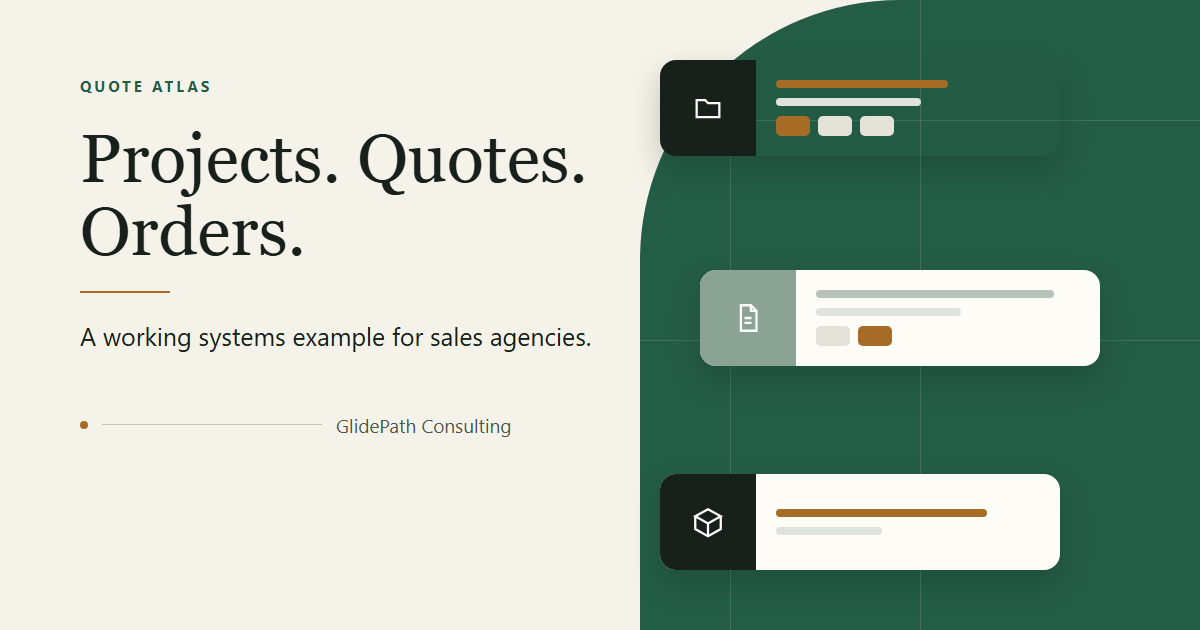
Quote Atlas, Sales Agency Project, Quote & Order Tracker

A fully functional demonstration built with fictional lighting and site-furnishings agency data. Follow projects across contacts, manufacturers, quote revisions, order discrepancies, acknowledgments, and follow-ups. Build a quote, resolve an order, or trace one company across every project in which it appears. Public demonstration, fictional data.

Launch Demo

Every project here started as one small piece of a larger operation. If one of these looks like your practice or your team, that is the conversation to have.

Let's talk about your business →
Illustration: two people talking across a table in a calm office.

How do AI tools fit into the work?

They're the primary instrument. GlidePath builds custom tools around how a business actually operates, not off-the-shelf software configured to fit. The tools belong to the client when the engagement ends.

Why not just use a chatbot?

A chatbot is a smart stranger. It has read the internet, and it has never met your business. The model is the easy part. What GlidePath builds is everything around it. A tool GlidePath builds:

  • Knows your records, your rules, and your way of doing things.
  • Gives the first-day hire the same answer as the owner.
  • Shows its source, and admits when it does not know.
  • Carries the know-how, so nobody has to be good at asking.
  • Does the job inside the work your team already does.
  • Is tested against failure before it reaches your team.

For what types of companies do you consult?

Founders and small teams, typically up to 50 people. Right now that means two kinds of clients:

  • Small medical practices
  • Lighting industry businesses

The operational friction GlidePath addresses is not specific to either industry.

What does a typical engagement look like?

Most engagements start with a fixed, three-month build: GlidePath installs the substrate and builds one tool. From there:

  • Some clients move into an ongoing retainer, with GlidePath watching what's been built and flagging what's next.
  • Others take what's built and run with it on their own.

How is client data handled?

The data-handling posture for each engagement is confirmed before work begins. Client content is never used to train external AI models. Engagements that touch regulated data, like HIPAA, PCI, or SOC 2 scope, are identified early and routed to a qualified provider rather than absorbed into the consulting scope.

Engagement Models

Prefer to schedule directly?

Book an Intro Call

30 minutes  ·  No agenda required

Phone

215-620-1160

Also available for confidential advisory and short sprints.